

Guide
How to make friends as an adult
Where to meet people, how to turn acquaintances into friends, starting your own group, and making friends in a new city or country.
Updated · 12 min read · By the getme team
1 in 2
Why making friends as an adult feels hard
At school and university, friendship mostly happens to you. You see the same people every day, you share experiences, and there's plenty of unstructured time. As an adult, those conditions disappear. Work, relationships, children, moving cities and long commutes all eat into the time and proximity friendships need.
You're far from alone if this is hard. In May 2023, the US Surgeon General published an advisory on loneliness and isolation which noted that about one in two adults in America reported experiencing loneliness. Similar concerns have been raised by governments and researchers in the UK, Australia and across Europe. Loneliness isn't a personal failing; it's a common result of how modern adult life is organised.
The good news is that friendship is a skill and a habit, not a matter of luck or personality type. This guide covers where to meet people, how to turn acquaintances into friends, how to keep friendships going, and how to use apps like getme without it feeling awkward.
What actually makes a friendship
Researchers who study friendship tend to agree on a few ingredients:
- Repeated contact. Seeing the same people regularly, ideally without having to plan each meeting from scratch.
- Time. Friendships deepen with hours spent together. Casual acquaintances become friends after a good number of shared hours, and close friendships take much longer.
- Shared activity. Doing something together gives you a reason to meet and something to talk about.
- Openness. Gradually sharing more about yourself, and responding well when others do.
- Initiative. Someone has to suggest the next meeting. Often, everyone is waiting for someone else.
Keep these in mind and you'll see why some approaches work better than others. A one-off networking event gives you contact once; a weekly running club gives you repeated contact, shared activity and built-in time.
Start with what you already have
Before looking for new people, look at the people already around you:
- Acquaintances you like. A colleague you chat with in the kitchen, a neighbour you wave to, a parent at the school gate. Many of these could become friends if someone suggested a coffee.
- Old friends. A message to someone you've drifted from ("I was thinking about that trip we did, how are you?") is often warmly received.
- Friends of friends. Ask a friend to bring someone along next time, or say yes when you're invited to things where you won't know everyone.
It can feel strange to "upgrade" an acquaintance. A low-pressure suggestion tied to something specific helps: "I'm going to check out that new bakery on Saturday morning, want to come?"
Places to meet new people
The best places share two features: you see the same people repeatedly, and there's an activity to focus on.
Clubs and classes
Sports clubs, running groups, choirs, climbing gyms, language classes, pottery, improv, book clubs, community gardens. Choose something you'd enjoy even if you didn't make a single friend, because that keeps you going long enough for friendships to form. Weekly is better than monthly.
Volunteering
Volunteering brings together people who care about the same thing, and it gives you a role so you're not just standing around. Food banks, parkrun volunteering, environmental groups, animal shelters, community events and local sports clubs are all options.
Your neighbourhood
Local life is underrated. Becoming a regular at a café, joining a community noticeboard, going to street parties or market days, and joining local groups all build familiarity. On getme, people near you appear first, and local classifieds for community notices and events help you see what's happening nearby.
Work
Work friendships can be lovely, but they're shaped by the job. Being part of a lunch group or an after-work activity helps; so does keeping in touch when someone leaves.
Online communities and apps
Apps for friendship work best when you use them to get offline. On getme, you can set your intent to friends, so people know you're not looking to date. Follow people with shared interests, comment on posts, and suggest meeting up when you've found common ground. Group templates make it easy to start a meetup of your own: a walking group, a board-game night, a language exchange.
Turning a first meeting into a friendship
You've met someone you like. Now what? This is where most potential friendships stall, because both people wait for the other to follow up.
- Follow up quickly. A message within a day or two ("Great to meet you at climbing, let's go again Thursday?") keeps momentum.
- Suggest something specific. "We should catch up sometime" rarely happens. "Coffee on Saturday at 10?" usually does.
- Make it repeatable. A regular plan (Tuesday runs, monthly dinners) removes the effort of planning each time.
- Invite them into your life. Bring them along to something with your other friends.
- Share a bit more each time. Friendships deepen through gradual openness: opinions, worries, hopes, small favours.
Don't keep score too strictly. In early friendships one person often does more of the inviting. If you've invited someone three or four times and they never suggest anything back, that's useful information, but many people are just bad at initiating and are glad when someone else does.
Being a good friend
Making friends is half the job; keeping them is the other half.
- Show up. Being reliable (turning up when you said you would, remembering what's going on in their life) builds trust quickly.
- Celebrate and support. Notice good news and difficult times. A message on the day of a job interview or after a hard week means a lot.
- Listen more than you advise. Most people want to be heard first.
- Be generous with small things. Lending a hand moving house, dropping off soup when they're ill, recommending them for a job.
- Repair after friction. If you've let someone down, say so. A simple apology repairs most things.
Making friends in a new city
Moving is one of the most common reasons adults find themselves without a local social circle. The first few months are the most important, because people are often most open to meeting newcomers when they first arrive, and habits form fast.
- Say yes to almost everything for the first three months.
- Pick one or two regular activities in your first fortnight.
- Tell people you're new. Locals often like recommending places and introducing people.
- Explore your neighbourhood on foot. You'll notice noticeboards, cafés and clubs.
- Use local groups and apps to find people near you who are also new.
Our moving to a new city guide covers the practical side as well as the social side. City pages such as London, Toronto, Amsterdam and Melbourne list neighbourhoods and local tips.
Friendship at different life stages
In your twenties
University and early jobs bring lots of people, but also lots of change. Many friendships drift as people move. Invest in the few that matter and keep meeting new people through shared interests.
When you're in a couple
Couples often drift into socialising only together or only with each other. Keep some friendships of your own, and make friends with other couples by doing activities rather than only dinner parties.
As a parent
Parent groups, school events and playgrounds bring people together, but conversation can stay stuck on children. Try suggesting an adults-only plan with a parent you get on with.
Later in life
Retirement, children leaving home or losing a partner can shrink a social circle quickly. Community groups, volunteering, classes and men's sheds or women's groups are good options, and many are designed for exactly this stage.
Dealing with shyness and social anxiety
If meeting people makes you anxious, you're in good company. Some approaches that help:
- Choose structured settings. Classes and clubs give you something to do and talk about.
- Prepare a few questions. "How did you get into this?" works almost anywhere.
- Set small goals. Talk to one new person, or stay for 30 minutes.
- Remember that most people are focused on themselves, not judging you.
- Be kind to yourself afterwards. Notice what went well, not just what felt awkward.
If anxiety or low mood is stopping you from doing things you want to do, talking to a GP or a mental health professional can help. Free helplines are listed on your country page, such as Australia, the US or Germany.
Conversation starters that go beyond small talk
Small talk is how most friendships start, and that's fine. To move past it, try questions that invite a story rather than a one-word answer:
- "What got you into this?" (at a class or club)
- "What's something you're looking forward to this month?"
- "What's the best thing about living around here, and the worst?"
- "What did you want to be when you were a kid?"
- "What's something you've changed your mind about recently?"
Then share your own answer. Friendship grows through back-and-forth openness, so match the other person's level of sharing and go a little further when it feels right.
Why it's worth the effort
Friendship isn't just pleasant. Research summarised in the Surgeon General's 2023 advisory links social connection with better physical and mental health, and links isolation with higher risks of a range of health problems. Friends help us through bad news, celebrate good news, and make ordinary weeks better. Making them takes effort, especially at first, but the effort compounds: each friend brings new people, ideas and invitations into your life.
Online friendship etiquette
When you're meeting people through an app:
- Be clear that you're after friendship. Set your intent and say it in your bio.
- Keep first meetings public and short, like a coffee or a walk.
- Respect boundaries. If someone isn't interested, let it go gracefully.
- Use the same safety sense you would for dating. Most people are lovely, but don't share your address or send money. Our dating safety guide applies to friendship meetups too.
Starting your own group
If you can't find the group you want, start it. It's easier than it sounds and it puts you at the centre of a new social circle.
- Pick a simple, repeatable activity: a Sunday walk, a monthly book club, a Thursday board-game night.
- Choose a regular time and a public place.
- Post it: on getme using a group template, on local noticeboards, and with friends.
- Show up every time, even if only two people come at first. Consistency is what grows a group.
- Welcome newcomers by introducing them to others.
Friendship for men
Many men find adult friendship particularly hard to build and maintain. Male friendships often centre on doing things side by side (sport, work, projects) rather than talking face to face, and when the activity stops, so does contact. There's nothing wrong with side-by-side friendship; it just needs a regular activity to keep it alive.
Practical ideas: join a five-a-side or social sports team, a cycling or running club, a men's shed or makerspace, a volunteer fire brigade or surf club, or a regular poker or games night. Then take the small step of checking in between activities: "How did the job interview go?" Many men say they'd welcome more of these messages but rarely send them.
Making friends across cultures and languages
If you've moved countries, friendship norms may be different from home. In some places people are warm with strangers but slow to invite you into their homes; in others, people seem reserved at first but are very loyal once a friendship forms. Neither is better. It helps to:
- Learn a little of the local language, even if everyone speaks English. It signals effort and opens doors.
- Mix with both locals and other newcomers. Other newcomers are often most open to new friends, while locals help you understand the place.
- Join something local, not just international. A neighbourhood sports club or volunteer group can be the fastest route to local friends.
- Be patient. In many northern European cities in particular, friendships form slowly through repeated contact.
When friendships change or end
Not every friendship lasts, and that's normal. People move, priorities change, and some friendships simply belong to a particular period of life. A few thoughts:
- Drifting isn't always failure. You can value a friendship that has run its course.
- Address problems directly when it matters. A calm, honest conversation can save a friendship that's been hurt by misunderstanding.
- Step back from friendships that consistently hurt you. If someone regularly belittles you, breaks confidences or only gets in touch when they need something, it's OK to invest less.
- Leave the door open. Many friendships revive years later.
A 30-day friendship plan
- Days 1 to 7: Message two old friends. Pick one regular activity and sign up. Set your getme intent to friends and fill in your interests.
- Days 8 to 14: Go to your activity. Talk to at least one new person. Suggest a specific follow-up with one acquaintance.
- Days 15 to 21: Go again. Invite someone you've met to a second, different activity: coffee, a walk, a market.
- Days 22 to 30: Host something small (drinks, a walk, a games night) and invite two or three people who don't know each other yet.
Frequently asked questions
How long does it take to make a friend?
It varies, but friendships take time spent together. Regular, repeated contact over a few months is usually what turns an acquaintance into a friend.
Is it weird to use an app to make friends?
Not at all. Many adults use apps to find people with shared interests nearby. Be clear about what you're looking for and meet in public.
What if nobody invites me back?
Keep inviting for a while; many people are bad at initiating. If it's always one-sided over months, invest more in people who respond.
How do I make friends if I work from home?
Build regular, in-person routines: a class, a club, a co-working day, or a regular café. Repeated contact is the key ingredient.
I'm new to the country. Where should I start?
Language exchanges, international groups, volunteering and local clubs are great starting points. getme's country pages, for example Spain or Germany, list cities and neighbourhoods.
How do I keep friendships going when we're busy?
Make it routine: a standing monthly dinner, a weekly walk, a recurring call. Routines survive busy periods better than spontaneous plans.
Can I use getme just for friends?
Yes. Set your intent to friends and you won't be shown as looking for a date. You can follow people, comment on posts, join conversations and suggest meetups, and anyone who prefers to keep things platonic can say so on their profile.
What's a good first friend meetup?
Something short, public and activity-based: a coffee, a walk, a market, a gallery or a class. It gives you something to talk about and an easy finish time.
What if I've lost touch with all my old friends?
Start small: send one friendly message to one old friend this week, with no pressure to meet. Many people are delighted to hear from someone they've drifted away from. Alongside that, join one regular local activity so you're also building new connections close to home.
Related pages
More guides
Use this stat
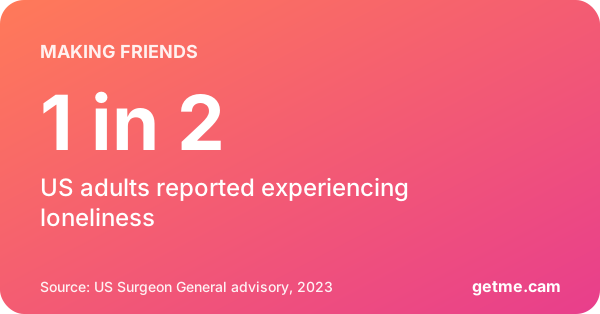
Source: US Surgeon General advisory, 2023. Free to embed with the credit link.