

Guide
How to find local jobs near you
Where to find work close to home, how to apply to small businesses, trial shifts, casual work, your rights and avoiding job scams.
Updated · 12 min read · By the getme team
26.8 min
Why look for work close to home
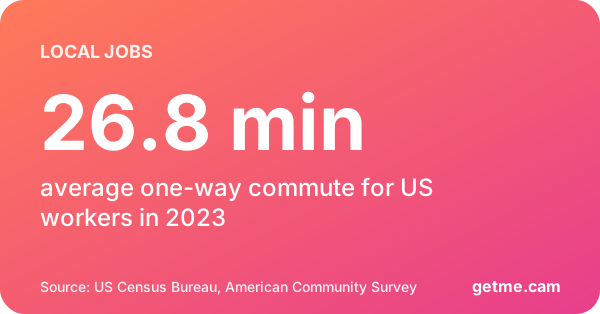
Working near where you live has real benefits: less time and money spent commuting, more flexibility for family and study, and a closer connection to your community. Commuting takes a meaningful bite out of the day. The US Census Bureau's American Community Survey put the average one-way commute for American workers at 26.8 minutes in 2023, which adds up to well over 200 hours a year for a full-time worker. In large cities, many people travel much longer.
Local jobs aren't only about shorter journeys. Small and medium businesses in your area (cafés, shops, trades, clinics, schools, care providers, gyms and offices) often hire through word of mouth and local networks rather than big job boards. If you know where to look and how to approach them, you can find opportunities other job seekers miss.
This guide covers where to find local work, how to apply in a way that stands out to small employers, what to expect from casual and part-time roles, how to protect yourself from job scams, and your basic rights. It's useful whether you're after your first job, returning to work, changing careers, or looking for something to fit around study or family.
Decide what kind of work you want
Start by being clear with yourself about what you need:
- Hours. Full-time, part-time, casual, weekends only, school hours, evenings?
- Pay. What's the minimum you need to cover your costs? Check the legal minimum wage in your country.
- Distance. How far are you willing to travel, and how? Walking, cycling, public transport or driving each change your radius.
- Type of work. What have you done before? What would you like to do? What are you willing to learn?
- Flexibility. Do you need a regular roster, or can you take shifts at short notice?
Write these down. They help you filter quickly and explain clearly to employers what you're offering.
Where to find local jobs
Local platforms and community boards
Platforms that show jobs near you save a lot of searching. On getme, local jobs are shown closest first, and you can browse by city, for example Melbourne or London. Community noticeboards, local social media groups and classifieds also carry small-business vacancies that never reach big job sites.
Walking in
For retail, hospitality and some trades, walking in with a short CV still works, especially in quieter times of day. Ask for the manager, be brief, and leave your CV. Look for "staff wanted" signs, but don't limit yourself to places that have them; many businesses hire when the right person turns up.
Your network
Tell friends, family, neighbours and former colleagues what you're looking for. Many local jobs are filled by recommendation before they're ever advertised. Be specific ("I'm looking for part-time admin work in the mornings, near the station") so people can think of opportunities.
Recruitment agencies
Agencies specialise in areas like hospitality, warehouse, admin, healthcare and trades. They can be a fast way into temporary or casual work, which sometimes becomes permanent. Legitimate agencies don't charge job seekers a fee to find them work.
Employers' own websites
Local councils, hospitals, schools, universities and larger local employers usually advertise on their own sites. Check them regularly.
Applying to small businesses
Small employers are often busy owners who don't have time to read long applications. Make it easy for them.
A short, clear CV
- One page if possible, two at most.
- Contact details, a two-line summary of what you're looking for, then recent experience and relevant skills.
- Highlight things small businesses value: reliability, flexibility, customer service, specific skills (barista, forklift licence, first aid, languages).
- Mention availability clearly: "Available weekdays 9am to 3pm and Saturdays."
- Keep it honest. Small business owners often call references.
A short message
When applying online, a short, specific message beats a generic cover letter. Mention the role, why you're a good fit, and your availability in three or four sentences. Refer to something about the business to show you've looked at it.
Profiles
On getme, a complete worker profile with a clear headline, skills, availability and a friendly photo makes it easy for local employers to contact you. Use the worker template to get the structure right.
Making your application stand out
Small employers often receive a handful of applications rather than hundreds, so a little effort goes a long way.
- Apply quickly. Many local roles are filled within days.
- Follow instructions. If the ad asks for availability or a particular detail, include it.
- Show you know the area. Mentioning that you live nearby and can cover short-notice shifts is a genuine advantage.
- Follow up once. A short, polite message a few days after applying shows interest without being pushy.
- Be reachable. Answer calls from unknown numbers while you're job hunting, and check your messages.
- Keep a simple tracker of where you've applied, when, and any follow-up, so you don't lose track.
If you don't get a role, it's fine to ask for brief feedback, and to ask the employer to keep you in mind for future openings. Local businesses often come back to good candidates when the next vacancy comes up.
Interviews for local roles
Local job interviews are often informal: a chat with the owner, a trial shift, or a quick call. Prepare anyway.
- Know the business. Visit beforehand if you can.
- Prepare examples of reliability, teamwork and handling a difficult customer.
- Be clear about availability and any constraints.
- Ask questions: hours, training, how rosters work, what success looks like.
- Dress appropriately for the workplace, one step smarter than the staff.
Trial shifts
Trial shifts are common in hospitality and retail. A short trial to show your skills can be reasonable, but in many countries unpaid trials beyond what's needed to demonstrate skills are not allowed, and you should be paid for productive work. Check the rules in your country and ask upfront whether a trial is paid.
Casual, part-time and seasonal work
Many local jobs are casual or part-time. Understand what you're agreeing to:
- Casual roles usually have no guaranteed hours. In some countries casual workers receive a higher hourly rate to compensate for fewer entitlements.
- Part-time roles typically offer regular hours with pro-rata entitlements such as paid leave.
- Fixed-term or seasonal roles last for a set period, such as the summer or the holiday season.
- Zero-hours contracts, used in some countries, offer no minimum hours. Know your rights to turn down shifts.
Always get your hours, pay rate and conditions in writing, even for short roles.
Know your rights
Employment law varies a lot between countries, but some basics are common:
- Minimum wage. Most countries set a minimum hourly rate, sometimes varying by age or sector.
- Payslips. You're usually entitled to a record of your pay and deductions.
- Breaks and maximum hours. Many countries regulate working hours and require rest breaks.
- Safety. Employers must provide a safe workplace and training for hazardous tasks.
- No discrimination. It's generally illegal to discriminate on characteristics such as sex, race, disability, age, religion or sexual orientation.
- Tax and contributions. Employers usually deduct tax and pension or superannuation contributions. Check they're doing it.
If something doesn't seem right, contact your country's workplace regulator or a union for advice. Government websites usually have free calculators and fact sheets on pay and conditions.
Avoiding job scams
Job scams target people who are keen to work, and they're increasingly common online. Warning signs:
- You're asked to pay, whether for training, a uniform, a background check or "starter kit". Legitimate employers don't charge you to work.
- The pay seems too good for simple tasks, like "earn hundreds a day liking videos" or "reviewing products".
- They want you to receive money or parcels and pass them on. This is often money laundering, and you could be held responsible.
- Interviews only by text chat, with no video or in-person meeting and no verifiable company details.
- Requests for your bank details or ID documents before any formal offer.
- Pressure to act immediately.
Check the employer's business registration (our country pages link to the right register, for example Ireland or Sweden), look for a real address and phone number, and search the company name with "scam". If you've been caught, contact your bank and report it to your national scam authority, listed on your country's safety page.
Getting your first job
If you've never had a paid job, you have more to offer than you think. Employers hiring for entry-level local roles mostly want reliability, a good attitude and the ability to learn.
- Use what you have. School responsibilities, volunteering, sport, caring for family members, babysitting and personal projects all show skills.
- Get a quick certificate. Food safety or first aid courses are short and make you more hireable in hospitality, retail and childcare.
- Ask a teacher, coach or volunteer coordinator to be a referee.
- Be flexible early on. Weekend and evening shifts are often easiest to get and can lead to better hours later.
- Practise a short introduction: who you are, what you're looking for, when you're available.
Returning to work after a break
Whether you've been caring for children or relatives, travelling, unwell, or out of work, returning can feel daunting. Some approaches that help:
- Be matter-of-fact about the gap. One line on your CV ("2021 to 2024: full-time parent") is enough. Employers are used to career breaks.
- Refresh skills. Short online courses, volunteering or a few temp assignments rebuild confidence and recent experience.
- Look for flexible or part-time roles to ease back in.
- Use your network. Former colleagues often know who's hiring and can vouch for you.
- Ask about return-to-work programmes, which some larger employers run.
Local work versus remote work
Remote jobs have widened the options for many people, but they're not always better. Remote roles attract applicants from everywhere, so competition is fierce, and some people miss the structure and social side of a workplace. Local jobs often have less competition, more personal connections and a better chance of getting to know the people you serve.
Many people combine the two: a local part-time job for routine and community, plus remote or freelance work for flexibility. Our freelancing and side gigs guide covers how to set that up.
Working in a new country
If you've recently moved, finding local work has a few extra steps:
- Check your right to work. Your visa or residence status determines whether, and how much, you can work. Employers may ask to see documents.
- Get the local tax and social security number you need (for example a tax file number in Australia, a National Insurance number in the UK, a Social Security number in the US, a SIN in Canada or a PPS number in Ireland).
- Translate your experience. Explain qualifications in local terms and check whether professional qualifications need to be recognised.
- Learn some of the local language if it isn't English. Even basic phrases help in customer-facing roles.
- Start with roles where your language and experience are assets: international businesses, tourism, tutoring, or businesses serving your community.
Our moving to a new city guide covers the practical steps of settling in.
Building a local career
A local job can be a stepping stone or a long-term career. To grow:
- Be reliable. In small businesses, reliability is often the fastest route to more hours and responsibility.
- Learn the business. Show interest in how it works, from stock to customers.
- Pick up certifications: food safety, first aid, responsible service of alcohol, forklift, trade qualifications. Many are short and inexpensive.
- Ask for feedback and act on it.
- Keep in touch with good managers and colleagues. Local industries are small, and recommendations travel.
Hiring locally as an employer
If you're a business owner hiring locally:
- Write a clear job ad: hours, pay, location, what the role involves, and what you need.
- Pay at least the legal minimum and follow award or contract rules.
- Keep trials short and fair, and pay for productive work.
- Check right-to-work documents where required.
- Be prompt and respectful with applicants; your reputation in the community matters.
On getme you can post a job and reach people nearby. Jobs posted publicly use structured data so they can appear in search results, and you can share a "See this job on getme" badge on your own site.
Local jobs in different countries
Where you live changes the details: minimum wages, how casual work is defined, tax, and which agency regulates workplaces. Some starting points:
- Australia: the Fair Work Ombudsman explains pay, awards and casual work. Browse jobs by city.
- United Kingdom: GOV.UK covers the National Minimum Wage and your rights. Browse UK jobs.
- United States: the Department of Labor and your state labor department cover minimum wage and hours.
- Canada: employment standards are mostly set by provinces and territories.
- Ireland and the EU: national labour inspectorates and citizens' information sites explain minimum wages and working-time rules, which follow EU directives.
Frequently asked questions
How do I find jobs near me?
Use local platforms that sort by distance, check community boards and classifieds, walk into businesses you'd like to work for, and tell your network. On getme, jobs near you appear first.
Should I walk in with a CV?
For retail, hospitality and some trades, yes. Go at a quiet time, ask for the manager, be brief, and leave a one-page CV.
Is it normal to do an unpaid trial shift?
A short trial to demonstrate skills can be acceptable, but in many countries you must be paid for productive work. Ask before you start.
How can I tell if a job ad is a scam?
Be wary if you're asked to pay, if pay is unrealistically high, if they want you to move money or parcels, or if you can't verify the business.
Can I work part-time while studying?
Usually, yes. Student visas may limit hours, so check your visa conditions if you're an international student.
What should I include in a short CV?
Contact details, a two-line summary, recent experience, relevant skills and certifications, and your availability.
How long should I wait to hear back?
Small businesses often decide within a week or two. If you haven't heard after a week, a short, polite follow-up is fine. If there's still no response, keep applying elsewhere; it's usually about their timing, not you.
Do I need a cover letter for local jobs?
Usually not. A short, specific message mentioning the role, why you're a good fit and your availability is enough for most small employers.
What if I don't have references?
Use teachers, coaches, volunteer coordinators or people you've done casual work for. A character reference from someone who knows you well and can speak to your reliability is often enough for entry-level roles. Be ready to give their contact details and ask their permission first.
Can I ask about pay before an interview?
Yes. It's reasonable to ask for the hourly rate or salary range, the expected hours and the type of contract before investing time in an interview. Many places now require pay ranges to be included in job ads.
Related pages
More guides
Use this stat
Source: US Census Bureau, American Community Survey. Free to embed with the credit link.